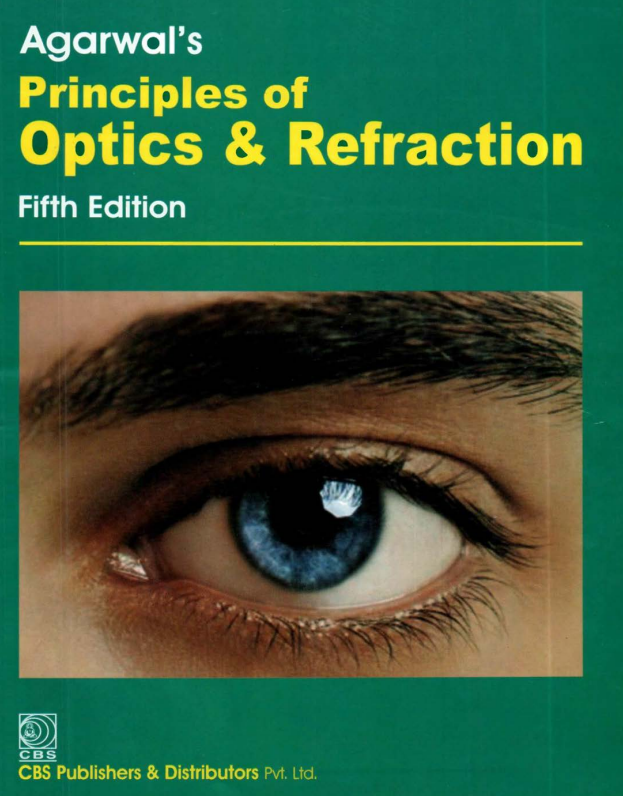
 Principles of Optics and Refraction is now in its 5th edition, the first edition having been published i,n 1961. This edition is being renamed as Agarwals Principles of Optics and Refraction. This book satisfies the needs of students and specialists, practitioners of ophthal mology and undergraduates and postgraduates alike. The book clearly elucidates the basic elementary principles of optics and refraction. While doing so, it introduces adequate though not complex mathematical calculations in such a way that they are easy to follow. It is written in simple English as it is spoken and understood by the students and practitioners in this country. The book contains practical hints which makes the understanding and practice of refraction easy. The book recognises that refraction is not only a science but it is also an art in its practice. The book has been revised with addition of material on lasers, elaborating descriptions on several optical principles adding new diagrams to make the written matter more understandable. Use of cross cylinders and its optics have been given in greater details to enable the student to put them in practical use. Use of keratometers, their principles and optics have been revised. To the description of autorefractors has been added some relevant material. Some classifications have been tabulated before their descriptions, e.g., classificatiop of anisometropia, aniseikonia, anomalies of accommodation, components of convergence. Convergence insufficiency has also been tabulated. At several places in ocular motility diseases, convergence, accommodation, etc. more details have been added including anatomical and physiological. Classification of squint has been tabulated. Material has been added in the chapter of contact lenses to make it more lucid. Low vision aid still poses a problem. Consider ably more material has been added in this chapter. Malingering is becoming more common with increasing industrialisation of the country. In view of this, information with regard to malingenng tests is included in this edition. The book has been so thoroughly revised that it has become quite comprehensive; though the style of presentation has been preserved1 physical optics. 2 physiological optics. 3 principles of opthalmic procedures. 4 errors of refraction. 5 accommodation and convergence. 6 orthoptics and squint. 7 contact lenses and low vision aids. 8 opthalmic lenses making and fitting of spectacles. This book satisfies the needs of students and specialists, practitioners of ophthalmology and undergraduates and postgraduates alike. The book clearly elucidates the basic elementary principles of optics and refraction. While doing so, it introduces adequate though not complex mathematical calculations in such a way that they are easy to follow. It is written in simple English as it is spoken and understood by the students and practitioners in this country. The book contains practical hints which make the understanding and practice of refraction easy. The book recognises that refraction is not only a science but it is also an art in its practice. The book has been revised with addition of material on lasers, elaborating descriptions on several optical principles adding new diagrams to make the written matter more understandable. Use of cross cylinders and its optics have been given in greater details to enable the student to put them in practical use. Use of keratometers, their principles and optics have been revised. To the description of autorefractors has been added some relevant material. Some classifications have been tabulated before their descriptions, e.g., classification of anisometropia, aniseikonia, anomalies of accommodation, components of convergence. Convergence insufficiency has also been tabulated. At several places in ocular motility diseases, convergence, accommodation, etc. more details have been added including anatomical and physiological. Classification of squint has been tabulated. Material has been added in the chapter of contact lenses to make it more lucid. Low vision aid still poses a problem. Considerably more material has been added in this chapter. Malingering is becoming more common with increasing industrialisation of the country. In view of this, information with regard to malingering tests is included in this edition. This book has been so thoroughly revised that it has become quite comprehensive; though the style of presentation has been preserved.
Read More
BookAuthor:
L.P. Agarwal (Author)
Version :
Fifth Edition - Original PDF
Publisher : CBS Publishers & Distributors
PublishDate : 30 April 2019
ISBN 978-8123906041